
Casino Licenses The Ultimate Guide (2026 Update)
Casino Licenses
The Ultimate Guide to Licenses (2026 Update)
Introduction
In the world of online gambling, a license means everything. It gives operators legal permission to conduct business and provides players with their only real safety net. However, not all licenses carry the same weight. While some represent the gold standard of player protection and strict oversight, others serve merely as «rubber stamps» that operators purchase for a few thousand dollars to gain a veneer of legitimacy.
Therefore, this guide provides an overview of the top gambling jurisdictions, explains the difference between B2C and B2B licenses, and highlights the regulatory trends shaping the industry in 2026. By the end of this article, you will know exactly which licenses you can trust and which ones to avoid.
Why a License Matters Casino Licenses
First of all, for a player, a license makes a promise. Specifically, it guarantees that the casino follows specific rules regarding fair play, fund security, and dispute resolution. Moreover, a valid license ensures that independent labs like eCOGRA or iTech Labs test the Random Number Generators (RNGs), so you know the casino cannot rig the games.
On the other hand, for an operator, a license represents necessity. Without it, banks refuse to process transactions, payment providers block accounts, and regulators blacklist the website. In short, a license separates a legitimate business from a rogue operation. Consequently, any serious operator will prioritize obtaining a valid license before launching their platform.
The Two Main Types of Casino Licenses
Before diving into jurisdictions, you need to understand the industry’s structure. Generally, regulators issue two categories of licenses:
B2C (Business-to-Consumer) License
This is the standard «Casino License.» Specifically, it allows an operator to offer games directly to players. Furthermore, it covers slots, table games, live dealer rooms, and sports betting.
B2B (Business-to-Business) License (Critical Supply License)
In contrast, this license applies to software providers. For example, if a company supplies the gaming platform or the RNG software to casinos (e.g., NetEnt, Playtech), the company needs a B2B license to guarantee its technology complies with regulations and operates fairly. Thus, both operators and software providers must understand which license category applies to their business.
The Hierarchy of Jurisdictions Casino Licenses
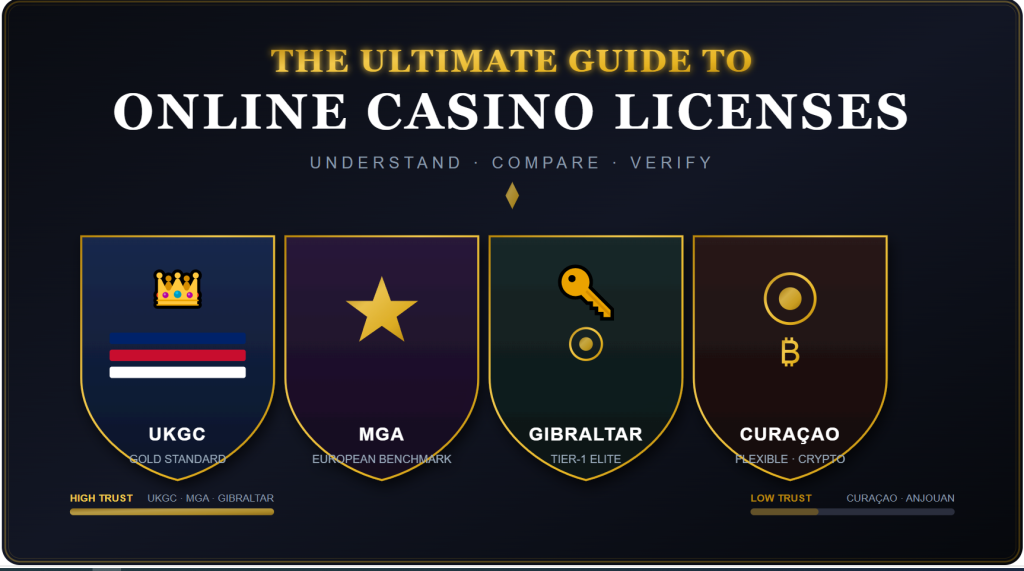
Undoubtedly, choosing the jurisdiction represents the most critical decision for any operator. Below, we provide a breakdown of the most common regulators in 2026, ranked by trust level.
1. The Gold Standard: UK Gambling Commission (UKGC)
-
Trust Level: Very High
-
Best for: Maximum player protection.
According to industry experts, players regard the UKGC as the strictest regulator in the world. As a result, casinos holding this license must comply with rigorous rules on advertising, affordability checks, and anti-money laundering (AML). However, this compliance comes at a high cost and requires full identity verification, making it unpopular with privacy-focused players. Nevertheless, operators need this license specifically to target the UK market.
2. The European Benchmark: Malta Gaming Authority (MGA)
-
Trust Level: High
-
Best for: International operations with strong credibility.
Meanwhile, the MGA represents the most common license for major international casinos. Notably, it balances strict regulation with operational flexibility. For instance, to obtain an MGA license (specifically Type 1 for casino games), an operator must have a minimum share capital of €100,000 and pass a strict «fit and proper» test. Therefore, players respect the MGA license highly across Europe.
3. The Elite «Tax Havens»: Gibraltar & Isle of Man
-
Trust Level: High
-
Best for: Tier-1 operators serving high rollers.
Similarly, these jurisdictions issue fewer licenses than Malta, but they associate with legacy, high-value brands. In addition, they enforce strict financial oversight and reserve fund requirements, making entry expensive but boosting reputation excellently. As a result, only established operators typically choose these jurisdictions.
4. The Flexible Option: Curaçao (2026 Update)
-
Trust Level: Medium (Increasing)
-
Best for: Crypto casinos and startups.
Historically, Curaçao represented the «easy» license—low cost, fast processing, and minimal checks. However, the landscape changed dramatically in 2025/2026. Specifically, the new system has abolished master licenses, increased enforcement, and introduced stricter player protection rules. Consequently, Curaçao remains the go-to choice for No KYC (Know Your Customer) casinos and crypto gambling, but players must exercise more caution here than with MGA/UKGC sites.
5. The New Low-Cost Competitor: Anjouan (Comoros)
-
Trust Level: Low to Medium
-
Best for: Startups wanting speed.
Additionally, this relatively new entrant gained popularity in 2025-2026. Specifically, Anjouan offers a «combo» license covering all game types (casino, betting, poker) for an annual fee of approximately €17,828. Moreover, it requires no local physical office, making it extremely attractive for startups. However, it lacks the international reputation of the MGA or UKGC. Therefore, we recommend approaching Anjouan-licensed casinos with caution.
6. Restricted Markets: Switzerland
-
Trust Level: High (but restricted)
Finally, unique jurisdictions like Switzerland operate on a closed model. Specifically, the government only issues licenses to land-based casinos to operate online (e.g., Grand Casino Luzern) and blocks foreign operators via DNS blocking. Thus, you will rarely encounter these licenses unless you live in that specific country.
What a License Covers (Scope)
It is important to note that a license does not provide universal permission. Instead, regulators define exactly what a casino can do:
-
Type 1 (Casino): Slots, roulette, blackjack, and live dealer games (the house always has the edge).
-
Type 2 (Betting): Sports betting against fixed odds.
-
Type 3 (P2P): Poker and bingo, where the casino takes a commission (rake), and players play against each other.
-
Type 4 (Skill): Fantasy sports or other skill-based contests.
For example, if a casino holds only a Type 2 license but offers slots, it operates illegally. Therefore, always check what license types the casino holds before you register.
Casino Licenses Key Compliance Requirements (KYC, AML, RNG)
To maintain a valid license, operators must adhere to strict ongoing obligations:
-
KYC (Know Your Customer): First, casinos must verify the identity (ID, address) and age of players to prevent fraud and underage gambling.
-
AML (Anti-Money Laundering): Second, they must monitor transactions for suspicious activity and report large sums to financial authorities. Additionally, they also need to appoint an MLRO (Money Laundering Reporting Officer).
-
RNG Certification: Finally, third-party labs (eCOGRA, GLI) must certify the software that determines game outcomes to ensure randomness. Without this certification, you cannot trust the fairness of the games.
How to Verify a License (For Players)
Do not simply trust the logo at the bottom of a website. In fact, scam sites frequently steal license numbers. Here is how to check:
-
Find the Number: First, scroll to the footer for the License Number and Company Name.
-
Don’t Click the Logo: Next, remember that fake sites use unclickable images. In contrast, real licenses always link to the official regulator’s database.
-
Check the Official Register: Then, go to the MGA or UKGC website and search for the number. Be sure to verify that the status says Active and the domain matches the website you are using.
-
Watch for Red Flags: Finally, if the website refuses to show a license number or the domain was registered only two months ago, avoid it. Otherwise, you risk losing your money.
Summary Comparison Table Casino Licenses
For a quick overview, here is a comparison of all the major jurisdictions discussed above:
| Jurisdiction | Trust Level | Cost | Speed | Best For | KYC Required? |
|---|---|---|---|---|---|
| UKGC | ★★★★★ | Very High | Slow | UK Market Players | Full Verification |
| MGA | ★★★★☆ | High | Moderate | General EU Players | Verification Required |
| Isle of Man | ★★★★☆ | High | Slow | High-Roller & VIP sites | Verification Required |
| Curaçao | ★★☆☆☆ | Low | Fast | Crypto & No-KYC sites | Minimal / None |
| Anjouan | ★☆☆☆☆ | Very Low | Very Fast | Startups & Agencies | Minimal |
As the table shows, there is a clear trade-off between trust level and convenience. Therefore, your choice of license depends on your priorities as a player.
The Future (Trends for 2026)
Looking ahead, the era of relaxed regulation is ending. In fact, in 2026, we are seeing a global shift toward stricter control:
-
Biometric KYC: First of all, the industry is moving beyond documents to fingerprint or facial recognition.
-
Increased Capital: Secondly, regulators are raising minimum capital requirements to ensure operators do not go bankrupt and run away with player funds.
-
Sweeping of «Weak» Licenses: Finally, authorities like Curaçao must reform to avoid European banks blacklisting them. As a result, even low-trust licenses will become safer over time.
Conclusion Casino Licenses
To sum up, if you want safety and have the patience for verification, choose MGA or UKGC. On the other hand, if you value privacy and speed with crypto, Curaçao remains the standard (and is becoming safer). Regardless of your choice, always verify the license yourself before depositing. Remember, a few minutes of checking can save you from losing your money to a rogue casino.